Saved a Membership Program with a Makeshift SSO

At the time, while working as a Community Strategist, I was brought in to turn a struggling community into a revenue driver: one that could offset losses if other areas of the business underperformed.

One key solution I implemented was an automation that saved the integrity of their membership program.

I’ve shared the full breakdown of this solution in Part 1 and Part 2 on LinkedIn.
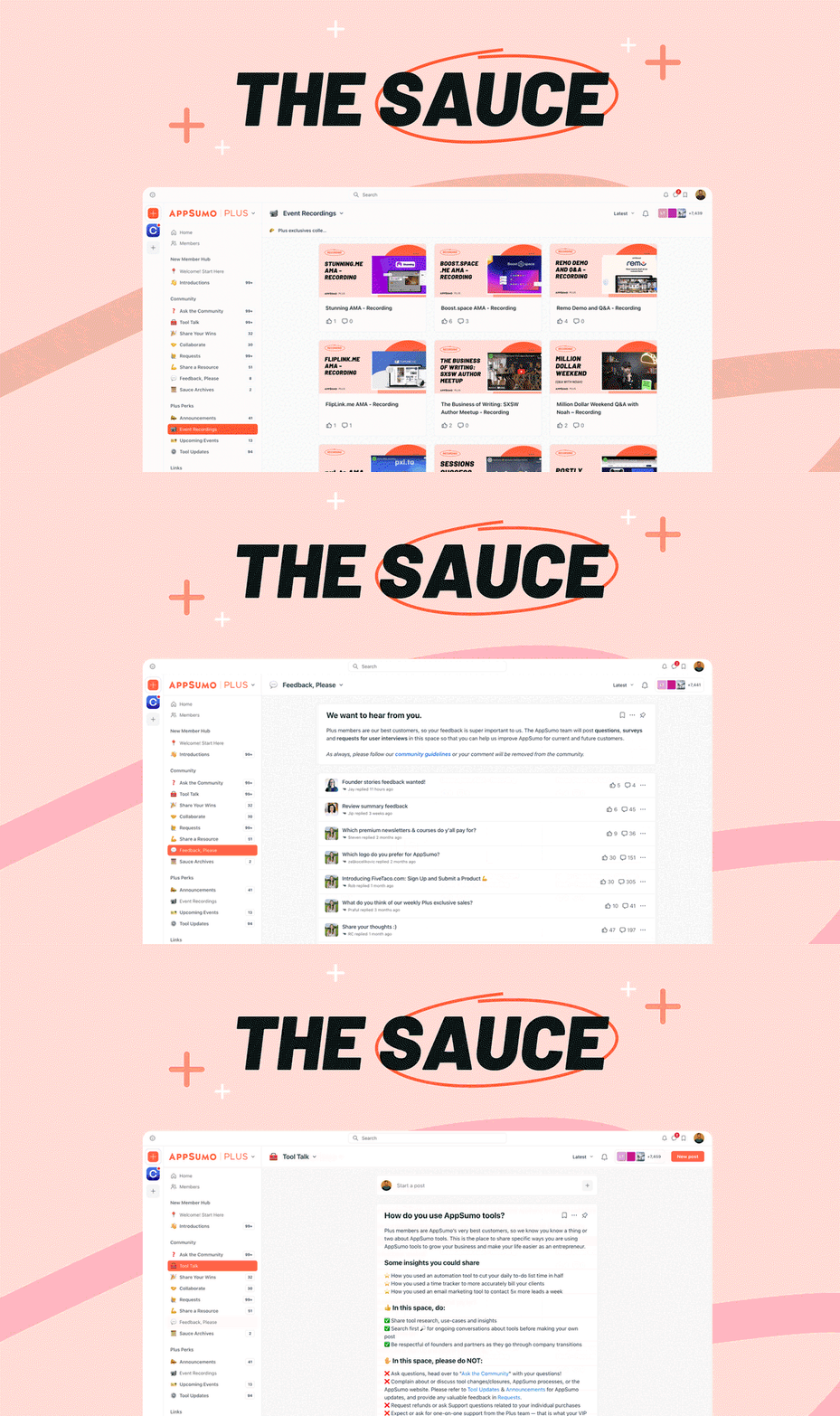
Header image
  • Partner logo
  • Partner logo
  • Partner logo
  • Partner logo
  • Partner logo

Thanks From The AppSumo Team

Chris demonstrated exceptional skills in community development and engagement. He developed strategies to foster growth, hosted educational webinars and overhauled our Circle community platform to make it more engaging. Chris is resourceful, smart, and passionate and able to build meaningful relationships and find innovative solutions to challenges.

Katie Weeks, Subscription Manager @ AppSumo

Chris contributed significantly to the changes that have taken place over the years. We truly appreciate everything he has done for us. Thank you from the bottom of my heart. 

Seann Stubbs, President @ AppSumo

Project Problems / Challenges

  1. Root-to-revenue visibility lacking – It was hard to understand if the revenue was actually coming from paid members or unpaid members.
     
  2. No automated access revocation – Unpaid members retained access which would have had a direct impact on the trust, integrity, security and revenue.
     
  3. Revenue tracking issues – Ambiguity in revenue streams worsens financial planning and reporting.
     
  4. Unreliable membership stats – MAU/DAU ambiguity prevents accurate growth and engagement analysis.
     
  5. SSO solution on hold – Delayed implementation reduces scalability and long-term efficiency.
     
  6. Manual processes were inefficient – Time-consuming, error-prone, but secondary compared to revenue/trust issues.

My Thought Process

  • Explored APIs to connect Stripe with Circle for automated access revocation.
     
  • Tested in a sandbox environment to avoid removing active members accidentally.
     
  • Handled email mismatches between e-commerce and community platforms.
     
  • Developed an exit strategy to encourage churned members to resubscribe.

The Automation
Emoji icon 1f3c6.svg

  • I had the Business Intelligence team create a script that would deposit all the emails of members who were paying onto a Google Sheet
  • I created an automation that exported the whole list of community members from the community platform to the same Google Sheet but on a different column.
  • Both lists were checked against each other and records were matched by their email in a spreadsheet
  • That spreadsheet became the temporary source of truth for access
  • The automation then removed non-paying members from the community in bulk if their email did not match the records of paying subscribers
  • Accounts weren’t deleted or deactivated. Only community access was revoked.
  • Members could regain access at any time by resubscribing to the membership.

This wasn’t perfect or scalable by any means but it reduced the risk of inactive members acting out and made the data as accurate as possible for community engagement and revenue tracking.

Lessons Learned

  • Community access must be intentional, not an afterthought It has to be treated it as a core part of the business, not a side perk.
     
  • Security and trust come first Even perks require proper controls (SSO, MFA, session timeouts, etc.).
     
  • Temporary solutions can work as compensating controls – A makeshift SSO can mitigate risk until proper tools are in place.
     
  • Clear guidelines and onboarding matter – Communicating with members about what the community is for and how members are expected to behave etc is so important.
     
  • Automation reduces human error – Setting up an automation that syncs with paying subscribers with community access prevents mistakes and preserves trust.
     
  • Exit strategies protect fairness – Ensuring that non-paying members lose access respectfully and can regain it if they resubscribe is vital.
     
  • Role-based access limits risk – Give members least privilege will reduce the risk of a mutiny.
     
  • Ongoing vigilance is needed – Check for shared links, alternate emails, and other ways perks can be abused.
     
  • Cross-tool security must be considered –The sooner a real SSO comes into play the sooner other automations can be sunsetted. An automation with 3-4 tools can be more vulnerable as they all have a different approach to security and patch management.